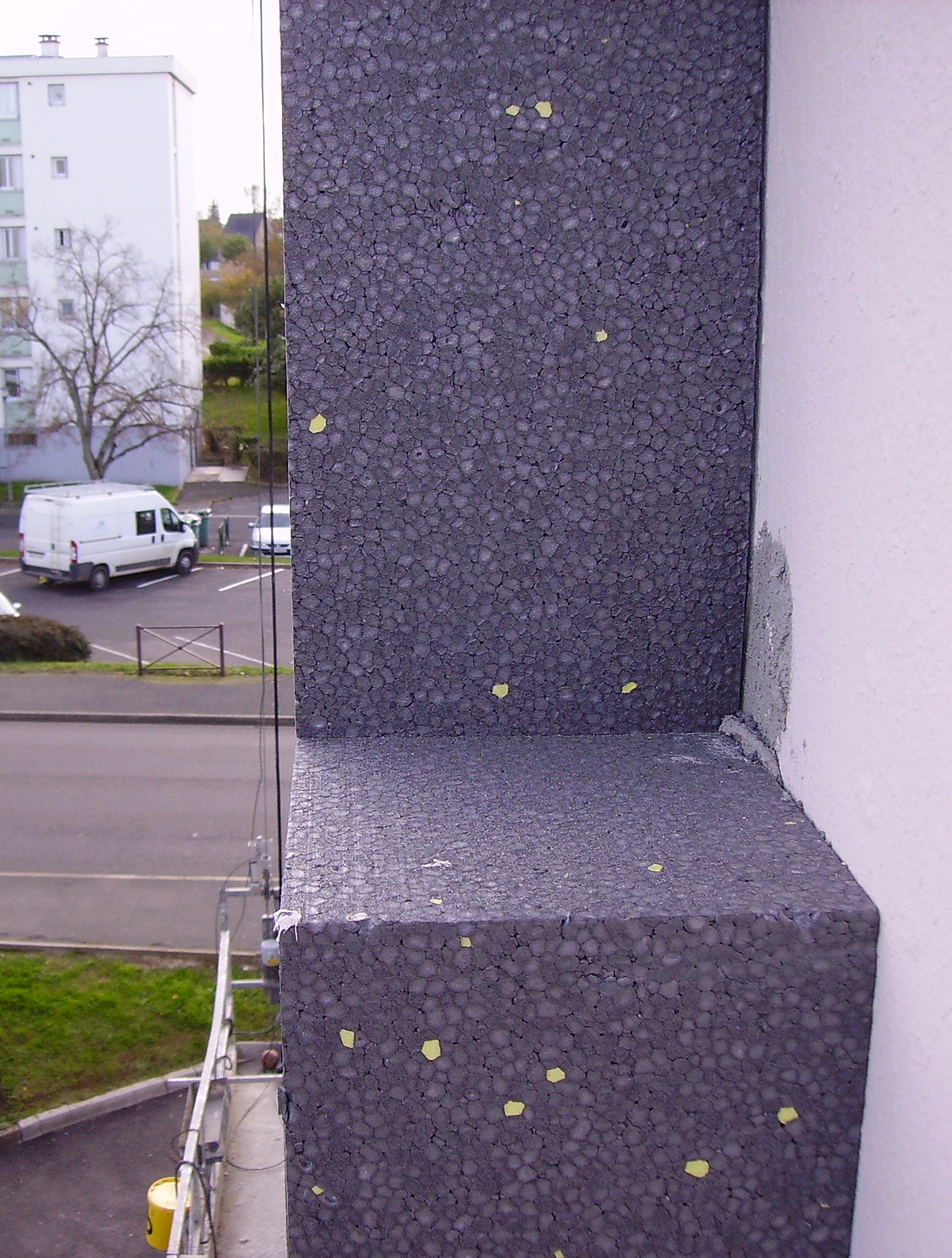
External thermal insulation composite systems (ETICS) — referred to as kontaktní zateplovací systém in Czech — account for the majority of wall retrofit projects in the Czech Republic. The system consists of insulation boards bonded and mechanically fixed to the existing wall, covered with a reinforcing mesh embedded in base coat and finished with a thin render. The choice of insulation board has significant consequences for thermal performance, fire safety, vapour management and overall system cost.
Expanded Polystyrene (EPS)
EPS boards are the dominant material in Czech ETICS projects by volume. Their declared thermal conductivity (λD) is typically 0.031–0.036 W/(mK) depending on density and whether graphite particles are incorporated (graphite EPS, marketed under trade names such as Neopor, achieves 0.030–0.032 W/(mK)).
Vapour Resistance
EPS has a vapour diffusion resistance factor (μ) of approximately 30–70. In a standard brick or concrete panel wall with EPS on the outside, the diffusion calculation under ČSN EN ISO 13788 typically shows no condensation risk within the board, provided the interior is not excessively humid.
Fire Classification
Standard EPS is classified E under EN 13501-1, meaning it is combustible. This limits its use in ETICS to buildings up to 12 m in height (measured to the top of the last habitable floor) under Czech Building Act No. 183/2006 Coll. and the associated technical regulations. Above 12 m, a non-combustible mineral wool perimeter strip at least 200 mm wide must be installed at each floor level, or the system must use mineral wool boards throughout.
Mineral Wool (Stone Wool and Glass Wool)
Stone wool (kamenná vlna) and glass wool (skelná vlna) boards manufactured specifically for ETICS have a declared thermal conductivity of 0.033–0.040 W/(mK), slightly higher than EPS. The thermal performance disadvantage is offset by non-combustibility: mineral wool boards are classified A1 or A2 under EN 13501-1, making them suitable for ETICS on all building heights.

ETICS-Specific Mineral Wool Boards
Not all mineral wool products are suitable for ETICS. The boards used in facade systems are compressed to higher density (typically 100–180 kg/m³) to provide adequate tensile strength perpendicular to the board face (σ10 ≥ 7.5 kPa for lamellar boards). Standard loft or cavity batts have insufficient compressive and tensile strength for bonded facade applications.
Vapour Permeability
Mineral wool has a vapour diffusion resistance factor of μ = 1–2, making it highly vapour-open. This is particularly relevant in timber-frame or lightweight steel-frame construction where vapour-open systems are preferred to avoid moisture accumulation in the structure.
Polyisocyanurate (PIR) Boards
PIR foam boards achieve declared thermal conductivity values of 0.022–0.025 W/(mK) — the lowest of the three materials. Their primary application is in situations where installation depth is constrained, such as under floor screeds, in flat roof assemblies or in internal insulation applications where reducing room dimensions is a concern.
Limitations in ETICS
PIR boards are less commonly used in Czech external ETICS systems than in Western European markets. The European Technical Assessments (ETA) available for PIR-based ETICS are fewer in number, and the fire classification of most PIR products is E or D, meaning the same height restrictions as EPS apply. PIR boards also have a higher μ value (approximately 50–150) than mineral wool and require careful vapour analysis in wall assemblies.
Comparative Overview
| Property | EPS 100 | Stone Wool (facade) | PIR |
|---|---|---|---|
| λD W/(mK) | 0.032–0.036 | 0.033–0.040 | 0.022–0.025 |
| Vapour resistance μ | 30–70 | 1–2 | 50–150 |
| Fire class (EN 13501-1) | E | A1 / A2 | D / E |
| Height restriction (ETICS) | ≤ 12 m (solo) | No restriction | ≤ 12 m (solo) |
| Typical thickness for U = 0.18 W/(m²K) on 450 mm brick | 160–180 mm | 180–200 mm | 120–140 mm |
Thickness Calculation Principles
The required insulation thickness depends on the thermal resistance of the existing wall construction and the target U-value. For a standard 450 mm solid brick wall (U ≈ 1.0 W/(m²K)), reaching the required renovation value of 0.30 W/(m²K) requires approximately 80–100 mm of EPS 100 or equivalent mineral wool. Reaching the recommended 0.18 W/(m²K) (passive house territory) requires 160–180 mm.
Detailed calculation follows ČSN EN ISO 6946 (thermal resistance and transmittance of building components) and should include the thermal resistance of interior and exterior surface air films (Rsi = 0.13 m²K/W, Rse = 0.04 m²K/W for walls).
Mechanical Fixings
Both EPS and mineral wool boards are typically bonded to the substrate with adhesive mortar covering at least 40% of the board face, and additionally secured with plastic-headed hammer fixings at a density of 6–8 per m². On soft substrates (lightweight concrete, autoclaved aerated concrete), fixing density increases and anchor penetration depth must be verified by pull-out testing.
Further reading: TZB-Info — Thermal Insulation Section | Roof and Attic Insulation Methods →