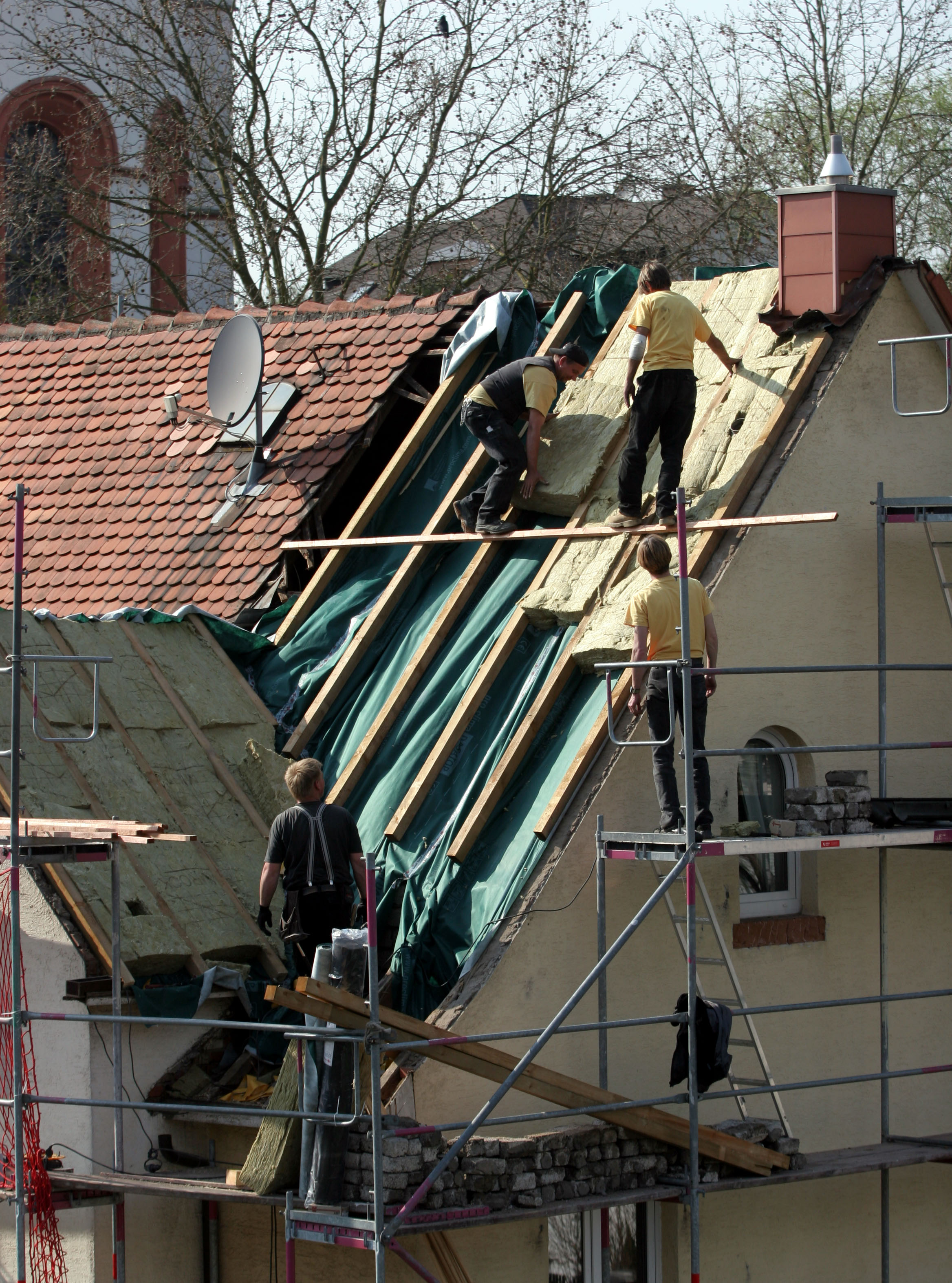
The roof is the component with the highest required thermal performance under ČSN 73 0540-2. For flat roofs and pitched roofs with habitable space directly beneath the roof cladding, the required U-value is 0.16 W/(m²K) for renovations and 0.24 W/(m²K) for the minimum permissible value. Achieving 0.16 W/(m²K) with mineral wool (λ = 0.036 W/(mK)) requires approximately 220–240 mm of insulation in the roof build-up.
Cold Attic (Flat Ceiling Insulation)
The simplest and most cost-effective approach in an unheated attic is to insulate the attic floor rather than the roof slope. Blown-in cellulose, loose mineral wool or rigid boards are placed between and over the ceiling joists. The attic space remains cold and ventilated, and no vapour control layer is required on the cold side of the insulation — moisture can escape freely into the ventilated attic.
Thickness for Cold Attic
Achieving U = 0.16 W/(m²K) over a standard concrete panel ceiling (Uexisting ≈ 1.2 W/(m²K)) requires approximately 200 mm of mineral wool (λ = 0.040 W/(mK)) or 160–180 mm of graphite EPS. Loose-fill mineral wool blown to 300 mm depth is a practical target that provides a comfortable margin above the required value.

Between-Rafter (Inter-Rafter) Insulation
In a warm attic conversion where the habitable space extends to the roof slope, insulation must follow the rafter line. The most common Czech approach is to fill the rafter depth with rigid mineral wool or EPS, then add a continuous layer of insulation below the rafters to eliminate the thermal bridge formed by the rafters themselves.
Rafter Bridge Correction
Timber rafters of typical dimensions (60×160 mm at 900 mm centres) create a repeating linear thermal bridge. If rafters occupy approximately 7% of the total roof area and the rafter λ is 0.13 W/(mK), the corrected U-value with only inter-rafter insulation is 10–15% higher than the calculation based on insulation alone. A 60 mm cross-battened layer of mineral wool below the rafters reduces this correction to under 3%.
Vapour Control Layer Placement
In a warm rafter system, the vapour control layer (VCL) is positioned on the warm side (interior side) of the insulation, immediately below the insulation or integrated into the interior lining board. The most common specification uses a variable-permeance membrane (sd value 0.3–6 m depending on ambient humidity) rather than a fixed low-permeance vapour barrier. This allows any moisture that enters the construction to dry out over time.
Sarking (Over-Rafter) Insulation
Sarking insulation places a continuous rigid board (PIR, EPS or mineral wool) directly on top of the rafters, beneath the counter-battens. This eliminates rafter thermal bridges entirely and is the preferred method for new construction and full roof recovers. The disadvantage is that existing roof tiles must be removed and the rafter tops must be structurally sound.
A typical Czech sarking specification uses 120–160 mm of PIR (λ = 0.023 W/(mK)) or 180–200 mm of EPS, taped at joints to achieve airtightness at the roof plane. The interior of the structure below the rafters remains fully accessible for services installation.
Flat Roof (Warm Roof)
Czech flat roof construction on multi-family housing predominantly follows the inverted warm roof principle: the waterproofing layer sits on the structural deck, with insulation boards placed on top and ballasted with gravel or paving. The inverted arrangement protects the waterproofing from thermal cycling and UV, extending its service life.
XPS in Inverted Roofs
Extruded polystyrene (XPS) is the standard insulation for inverted flat roofs because of its very low water absorption (≤ 0.7% by volume under long-term immersion, EN 12087). EPS and mineral wool are not suitable for this position — direct contact with pooled water causes significant deterioration of thermal performance over time.
Thickness Increase Factor
In inverted roof design, a correction factor (fx) is applied to account for rainwater cooling beneath the insulation layer. Czech practice follows ČSN EN ISO 6946 Annex D; for a ballasted inverted roof with annual rainfall in Prague of approximately 500 mm, fx is typically 0.05–0.10, requiring an additional 10–15% insulation thickness compared to a conventional warm roof.
Insulation Thickness Summary
| Roof Type | Material | Required Thickness (U = 0.16) |
|---|---|---|
| Cold attic floor | Mineral wool λ 0.040 | ≈ 240 mm |
| Between rafters + below | Mineral wool λ 0.036 | ≈ 200 mm total |
| Sarking over rafters | PIR λ 0.023 | ≈ 140 mm |
| Inverted flat roof | XPS λ 0.034 | ≈ 200 mm (incl. fx) |
Airtightness
Roof insulation loses a significant portion of its effectiveness if the building's airtightness is not addressed simultaneously. Air leakage through gaps in the ceiling or at junctions with walls can transport moisture-laden interior air into the insulation layer, causing interstitial condensation that reduces the effective R-value by 20–50% in severe cases. Czech passive house criteria specify n50 ≤ 0.6 h⁻¹; a typical unimproved Czech panel-block building measures n50 = 2–5 h⁻¹.
Further reading: TZB-Info — Roofing Section | Energy Audit Procedures →